Go big or go home. Or, go big and go home. Prior to moving to our home in Texas, we lived in a small apartment in Upstate New York. Our “dinning room table” there had been a 2 foot by 4 foot Ikea ‘desk’, and it had fit our needs quite nicely. However, when we moved into an actual house and tried to set it up in our new dinning room the result was nothing short of comical. We made the decision to set our table up in the kitchen area instead and that, at some point, I would build us a dinning room table that could seat more than two and half people.
Around this same time, we had a huge Elm tree cut down in our front yard, and I asked the tree guys to leave me an eight foot chunk of the trunk. After about a month of struggling with it, I cut it into two four-foot sections and rolled them by hand to our driveway. Two years later, I had a friend take one of those sections to a mill and got back eight or so ~2″ thick slabs. I stickered them in our garage and turned my attention elsewhere. I had an idea in my head for how I would make them into a table top, but I was stuck on how to make the base. I looked at thousands of ideas online, went into dozens of furniture shops, and came up with nothing. Everything I saw was either impractical or too common to be worth the effort. The top was going to be heavy and long, and I wanted the base to be unique enough that it added to the table as a whole without just disappearing.
One day, while I was working on something completely unrelated, inspiration struck. What if I used engine blocks as pedestals? They’d have the weight needed to stabilize the top, and would provide the design element that I’d been missing. At the time I had two Jeep 4.2l engine blocks in my shop (hence the epiphany), but they were already sold. So I made a trip to Vilas Motor Works (a local engine shop that I’d used for my engine rebuild) and casually mentioned that, if they had any engines come in that couldn’t be rebuilt, I’d be interested in buying them. These guys already had an idea that I was crazy (stupid?) and replied that, if I wanted it and could haul it away, I could have “that thing” for free. “That thing” was an early ’90s Ford 7.3l V8 diesel engine consisting of: the block, heads, oil pan, crank and cam shafts. Boom. Done. “I’ll be back with a truck tomorrow.” After getting it back to my shop I wrestled the parts around a couple times and started imagining how I could turn it into what I wanted. What I came up with was to use the cast iron heads as “feet” with eight Model A camshafts for legs that would hold the block up, and then have the wood top mounted to it. The Ford 7.3L is around 980lb fully assembled, my configuration would be about 800lbs without the top mounted. Our dinning room floor is hard wood laid directly on a cement slab, so I rationalized that everything would be fine.
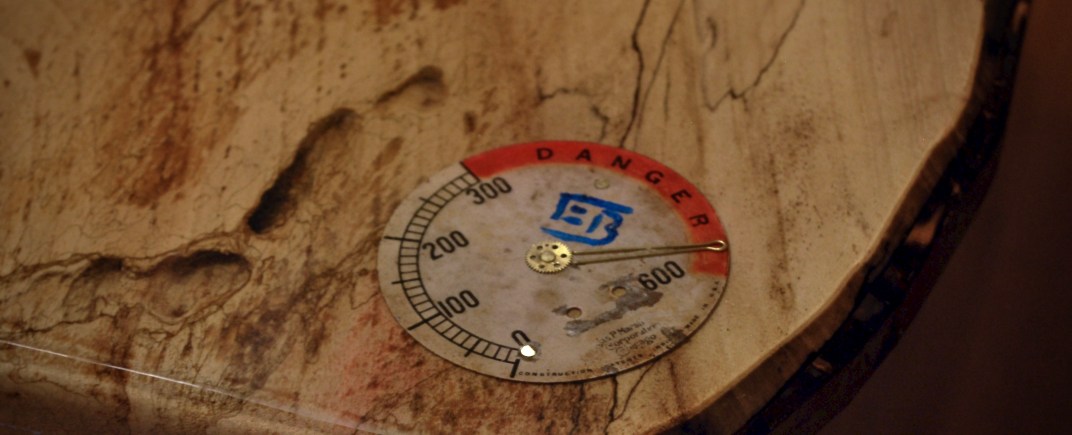
I moved all the motor parts out of the way and, with the help of a friend, started in on making the top. Rather than cutting all the Elm slabs square and joining them together, we laid all the pieces out so that the “live” edges pieced together. This tree must have known it was destined to be a table, and with very little trimming, all the slabs matched up with one another and made a nine foot by three foot top. I built a frame out of 2×6’s and screwed all the slabs in place to prevent them from shifting. We then spent 4 days with a router on a steel sled planning both sides down from ~2″ thick to ¾”. We then used the router to carve one inch wide and an eighth of an inch deep grooves down the length of the top, one on the bottom and two on the top. I set three 1″x ⅛” pieces of steel flat bar into the grooves, and fastened them with some counter sunk brass slotted screws. We removed the frame and added two more lengths of steel flat bar with brass screws to the outside edges, then set the whole thing into a 3″ deep mold. The flat bars hold all the slabs together, but would in no way be enough to make the top structural. To make everything solid, I used a two-part pour on bar-top style epoxy. I won’t get into how many gallons of epoxy (many) we had to mix and pour, but the result is that the entire top is encapsulated in crystal clear epoxy. This retains all the character of the wood, the cracks/gaps/live edges/worm holes, while still allowing for a glass-smooth surface. As a finishing touch, I embedded an old pressure gauge face with a custom brass needle and my logo.
Whith the epoxy was curing, I got back to working on the base. In order to support the length of the top, I took two eight-foot sticks of 2″ by 4″ rectangular steel tube that I could affix to the underside of the wood top. These then slide into two slots I cut into the engine block. Four spinning lug nuts from a semi truck were welded onto the tubes, and they screw onto four corresponding bolts that are welded to boxed plates on the table legs. This would allow for adjustability at four points to level the top if the floor turned out to be uneven or sloped. Because the block and the heads are cast iron, they can’t be welded to easily. To get around this, I cut sections of 8″ wide steel C channel to the length of the heads and drilled holes to correspond to the bolt holes on the heads where they would have bolted to the block. I then welded the camshafts to these plates and, after cleaning and polishing everything up, bolted everything together.
As that was progressing, we broke the top out of the mold and I used a special bit on my router to put a 45º chamfer around the top edge. That got a thorough sanding and another light coat of epoxy, and then the top was done. Meanwhile, all the steel parts got a heavy coating of clear enamel, and I covered or plugged all the openings in the block/heads/tubes so that my son couldn’t try to hid his legos in them. To finish everything up, I affixed sheets of heavy-duty synthetic felt to the bottoms of the feet so that the table wouldn’t scratch the wood floor and could be shifted around as needed.
Finally, everything came apart, got loaded onto a cart, and moved into the house in pieces. I brought my engine hoist into the dinning room (my wife loved that), and boosted up the block to re-bolt the whole mess back together. That done and ready, another friend came by and we carried in the top and positioned it on the base. I tightened the top down and PRESTO, our dinning capacity went from 2.5 to 10 people, 12 if you don’t mind being cozy. Best estimates are that the table, fully assembled, is just north of 1,000lbs… So chances are good that, if we ever move, the table stays with the house.
Wow that’s a lot of text… but then again, it is a LOT of table.


 9 Bar Welding